This WWW Guide reflects my own views on adsorption on heterogeneous surfaces and is "phenomenologically oriented". It is based mainly upon my own research (my papers, my PhD and unpublished results) as well as some papers/views of my co-workers (those from the past and current ones), generally agreed-upon views of an informal group of researchers and results available in other sources, e.g. books.
Most of the text, equations and figures deal with adsorption from dilute solutions or gas adsorption. Where possible, the possibility of using equations formulated for gas (or vapour) adsorption in adsorption from dilute solutions - and vice versa is pointed out. The general approach to adsorption from liquid mixtures is also presented.
This Overview page presents a summary of problems this Guide tries to explain or help to solve in a simple, practical way. Each of the listed problems is shortly explained and more is available through series of hyperlinks. Most (though not all of the sub-pages) may be accessed directly by using links in the index (left frame). All external links (to other sites) within this WWW site as a default are opened in new windows. Internal links within right frame are opened by default in the same frame. Many of the sub-pages may be reached in several ways.
How to distinguish a type of isotherm your adsorption data (gas, dilute solution) fits?
Data fitting/Optimisation You may, of course use some data-fitting package, but generally if you have more than 2 parameters you'll have a "reasonable fit" for almost any adsorption data and isotherm equation!!!
Here is some advice on adsorption data fitting (tricky!).
Use a Graham plot: [θ/(1-θ)] / c vs. θ (replace Conc with Pressure for gas adsorption) and find your type of heterogeneity (if any) and lateral interactions (if needed).
(Here are model pictures for the same isotherms and parameters as for Langmuir linear plot above)
NOTE. Graham plot requires a monolayer capacity to be known in advance (or to be determined in in independent way) in order to calculate θ = a/am. Another problem is multilayer buildup - in order to be able to make a Graham plot, data must be reduced to monolayer by application of appropriate "correction" (amulti → amono < am).
isotherm with Henry region (results from max. energy condition)
Henry constant
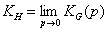
Henry constant KH is defined as:
KH = limp→0(KG)
or
KH = limc→0(KG)
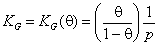
where: KG = [θ/(1-θ)]/p (gas adsorption)
or KG = [θ/(1-θ)]/c (dilute solute adsorption) is Graham's equilibrium function .
This condition is in fact equivalent to:
limp→0(φ) = 1
or
limc→0(φ) = 1
where:
φ = ∂ log(a)/
∂ log(p)
or
φ = ∂ log(a)/
∂ log(c)
is so-called φ-function.
It is usually believed, that the very existence of such a limit is a consequence of the existing maximum adsorption energy and is sometimes called a "physical consistency condition". However as it is easy to prove that it is enough that the energy distribution function defined in energy range (-∞ , +∞) behaves in a special way and such a limit is obtained (e.g. for Toth, RP or Gauss distribution-derived isotherm equations).
"Unified Theoretical Description of Physical Adsorption from Gaseous and Liquid Phases on Heterogeneous Solid Surfaces and Its Application for Predicting Multicomponent Adsorption Equilibria", A.W.Marczewski, A.Derylo-Marczewska and M.Jaroniec, Chemica Scripta, 28, 173-184 (1988) (pdf, hi-res pdf available upon e-mail request).
Quite often, some adsorption data may be well described by more than 1 isotherm equation. If underlying energy distributions are of similar character (e.g. both are symmetrical quasi-gaussian), we may try to estimate parameters of another eqn. by using already determined parameters.
"Relationships Defining Dependence Between Adsorption Parameters of Dubinin-Astakhov and Generalized Langmuir Equations", M.Jaroniec and A.W.Marczewski, J.Colloid Interface Sci., 101, 280-281 (1984),
(doi).
"Correlations Among the Parameters of Dubinin-Radushkevich and Langmuir-Freundlich Isotherms for Adsorption from Binary Liquid Mixtures", A.Derylo-Marczewska, M.Jaroniec, J.Oscik and A.W.Marczewski, J.Colloid Interface Sci., 117, 339-346 (1987),
(doi).
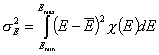
For some isotherm equations the energy dispersion σE may be calculated very easily (see here).
Data analysis - global heterogeneity/non-ideality:
NOTE. Monolayer adsorption only - if multilayer effects are visible, the isotherm must be "monolayerized", i.e. multilayer part must be estimated and removed.
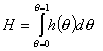
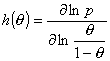
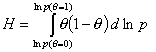
Global heteorgeneity, H, concept allows to estimate a single value characterizing the entire non-ideality of the adsorption system (i.e. both adsorbate and adsorbent). By using additional adsorption data measured on homogeneous surface the lateral interaction part of the non-ideality (Hint may be separated) and a part of non-ideality related to the system energetic heterogeneity may be determined (H = HE - Hint).
"A New Method for Characterizing the Global Adsorbent Heterogeneity by Using the Adsorption Data", A.W.Marczewski, M.Jaroniec and A.Derylo-Marczewska, Mat.Chem.Phys., 14, 141-166 (1986),
(doi)).
For several isotherm equations H may be calculated very easily (see here).
Try simple linear dependencies using only experimental adsorption and concentration (or their functions, e.g. logarithms) - methods are equation-specific and you must decide what type of equation should be checked (Here are model pictures):
Presented linear dependencies include: L, LF, BET, F, DR and DA isotherms.
NOTE 1. Some of the methods may require adsorption monolayer (adsorption capacity), am or e.g. characteristic micropore filling concentration, co, to be know in advance (estimated by independent method or LSQ-fitted - in this case, linear plot is only a verification).
NOTE 2.Replace concentration, c, by pressure, p, for gas adsorption. In dilute solute adsorption x=c/cs and in vapour adsorption x=p/ps, where index "s" indicates saturation concentration or pressure, respectively.
Use a so-called:
φ-function method
(where
φ = ∂ log(a)/
∂ log(c)) (derivative of adsorption isotherm in logarithmic co-ordinates). φ-function is a dimensionless (independent of adsorption and concentration/pressure units as well as independent of type of logarithm you use). Various plots of φ-function versus adsorption, pressure etc. allow to determine isotherm type and isotherm parameters (or sometimes at least to reject some existing choices)
(Here are model pictures)
Presented methods include analysis of: RP, Jossens, GL (partially), F, DR and DA isotherms.
NOTE. This method allows to determine equation type and parameters very precisely, however your data should be very good - evenly spaced, smooth and in a wide range of relative adsorption φ) - method is sensitive to data scatter.
Proposed method assumes that a certain correlation (generally non-linear) exists between adsorption energies of various adsorbates on a solid surface. Generally no limit of no. of components exists. Prediction requires data for simple (single-component or binary) systems.
For more info consult this paper (more is here):
"Unified Theoretical Description of Physical Adsorption from Gaseous and Liquid Phases on Heterogeneous Solid Surfaces and Its Application for Predicting Multicomponent Adsorption Equilibria", A.W.Marczewski, A.Derylo-Marczewska and M.Jaroniec, Chemica Scripta, 28, 173-184 (1988) (pdf, hi-res pdf available upon e-mail request).
This method may predict adsorption (or at least is able to estimate the magnitude of heterogeneity effects) in many situations:
Prediction of adsorption in gas mixtures (required: single gas adsorption data for all components; useful: binary gas mixture data - if e.g. prediction of tertiary-mixture adsorption is wanted; quality of prediction - very good).
Prediction of adsorption in multi-component dilute solutions (required: single solute adsorption data for all components; useful: binary dilute solute adsorption data - if e.g. prediction of tertiary mixture adsorption is wanted; quality of prediction - good or very good).
Prediction of adsorption in liquid mixtures (required: single gas/vapour adsorption data for all components; useful: binary gas mixture data - if e.g. prediction of tertiary-mixture adsorption is wanted; quality: heterogeneity parameters are nicely estimated, other parameters require correction) (for the prediction in e.g. tertiary systems, it is much better if binary liquid mixtures are available)
Proposed method assumes that all adsorbates are similar in chemical properties and their distributions af adsorption energies have the same shape but different position on energy axis (same heterogeneities, different adsorption equilibrium constants). Generally no limit of no. of components exists. Prediction requires data for simple (single-component or binary) systems.
In the light of the above presented prediction method as well as a heterogeneity vs. molecular size and heterogeneity study it is crude oversimplification. However, the usefulness of this approach may overcome its limits.
E.g. for wastewater treatment, where usually a large and only partially known no. and kind of pollutants is present. In such a case, if only an approximate mixture-profile is known, the adsorption of the entire mixture may be quite well predicted. In this way the right amount of adsorbent (e.g. active carbon) may be determined with a narrow margin error.
For more info consult e.g. this paper (more is here):
"A Simple Method for Describing Multi-Solute Adsorption Equilibria on Activated Carbons", A.W.Marczewski, A.Derylo-Marczewska and M.Jaroniec, Chem.Engng.Sci., 45(1), 143-149 (1990),
(doi).
Theoretical approach based on simple statistics.
The proposed theoretical approach does not assume any particular adsorption isotherm, though localised physical adsorption in monolayer is implied. It is assumed, that the observed heterogeneity comes from the entire system: i.e. specific properties of adsorbate and adsorbent as well as the topography of adsorption sites.
(Here are model pictures)
For more info consult this paper (more info is here)::
"Energetic Heterogeneity and Molecular Size Effects in Physical Adsorption on Solid Surfaces", A.W.Marczewski, A.Derylo-Marczewska and M.Jaroniec, J.Colloid Interface Sci., 109, 310-324 (1986),
(doi).
(This paper is probably my most-often cited one and I must say it gave me a lot of fun to find all this!)
This approach explained several observed facts and helped to reject some wide-spread (at that time) myths
(here).
for quasi-gaussian energy distribution characterised by heterogeneity coefficient m and components with size ratio r12 = r1 / r2 in conditions where adsorbed layer is almost filled-up an equation is obtained (M.Jaroniec,1981; M.Jaroniec et.al. 1982):
[a1 / a2r12 ] = { K12 [c1 / c2r12] } m
Most useful forms of this equation are linear.
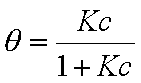
Monolayer (flat surface) adsorption (local isotherm - Langmuir) ( read more ) :
All those equations are based on so called General Integral Equation and may include lateral interactions (of FG, simplified Kiselev and full Kiselev type - see above) or multilayer formation (BET etc.).
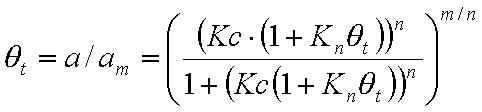
GL - Generalized Langmuir aka. Marczewski-Jaroniec - i.e. local Langmuir isotherm + surface heterogeneity controlled by 2 parameters (m,n), for specific parameter values GL equation reduces to Langmuir (L)(homogeneous), Generalized Freundlich (GF), Langmuir-Freundlich (LF) and Tóth (T) isotherms.
Sq - "Square" aka. UNILAN ( read more ) - monolayer physical adsorption with continuous (constant) energy distribution
; related to a non-monolayer Tiemkin eq. (also below).
"Gauss" (G)( read more ) and Rudzinski (R) ( read more ) - monolayer physical adsorption with (true) Gaussian (G) and quasi-gaussian (R) energy distribution.
Some other monolayer isotherms:
Jov - Jovanovic eq. - vertical interactions bulk/surface phase ( read more ); may be extended with heterogeneity effects.
Volmer - Volmer eq. - mobile physical gas adsorption on homogeneous surface ( read more ).
Multilayer isotherms (x = c/cs or x = p/ps) - most based on BET equation ( read more ) :
Other experimental isotherms ( read more ) :
Not limited by monolayer capacity; may show maximum adsorption for dilute solutions of weakly soluble substances or vapours because of concentration/pressure limit
 Data fitting/Optimisation
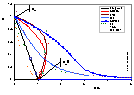
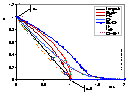 Use a linear Langmuir plot (compare other linear plots below): Ads vs. Ads / Conc (replace Conc with Pressure for gas adsorption) and find your type of heterogeneity (if any), lateral interactions (if needed) or multilayer buildup "correction" e.g. for L, Kis, FG, GL, GF, LF, GF-Kis, GF-BET equations (i.e. Langmuir, Kiselev, Fowler-Guggenheim, Generalized Langmuir aka. Marczewski-Jaroniec, Generalized Freundlich aka. Sips and Langmuir-Freundlich as well as some eq. combinations).
(Here are model pictures):
Use a linear Langmuir plot (compare other linear plots below): Ads vs. Ads / Conc (replace Conc with Pressure for gas adsorption) and find your type of heterogeneity (if any), lateral interactions (if needed) or multilayer buildup "correction" e.g. for L, Kis, FG, GL, GF, LF, GF-Kis, GF-BET equations (i.e. Langmuir, Kiselev, Fowler-Guggenheim, Generalized Langmuir aka. Marczewski-Jaroniec, Generalized Freundlich aka. Sips and Langmuir-Freundlich as well as some eq. combinations).
(Here are model pictures):
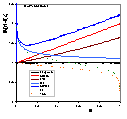
 Use a Graham plot: [θ/(1-θ)] / c vs. θ (replace Conc with Pressure for gas adsorption) and find your type of heterogeneity (if any) and lateral interactions (if needed).
(Here are model pictures for the same isotherms and parameters as for Langmuir linear plot above)
Use a Graham plot: [θ/(1-θ)] / c vs. θ (replace Conc with Pressure for gas adsorption) and find your type of heterogeneity (if any) and lateral interactions (if needed).
(Here are model pictures for the same isotherms and parameters as for Langmuir linear plot above)